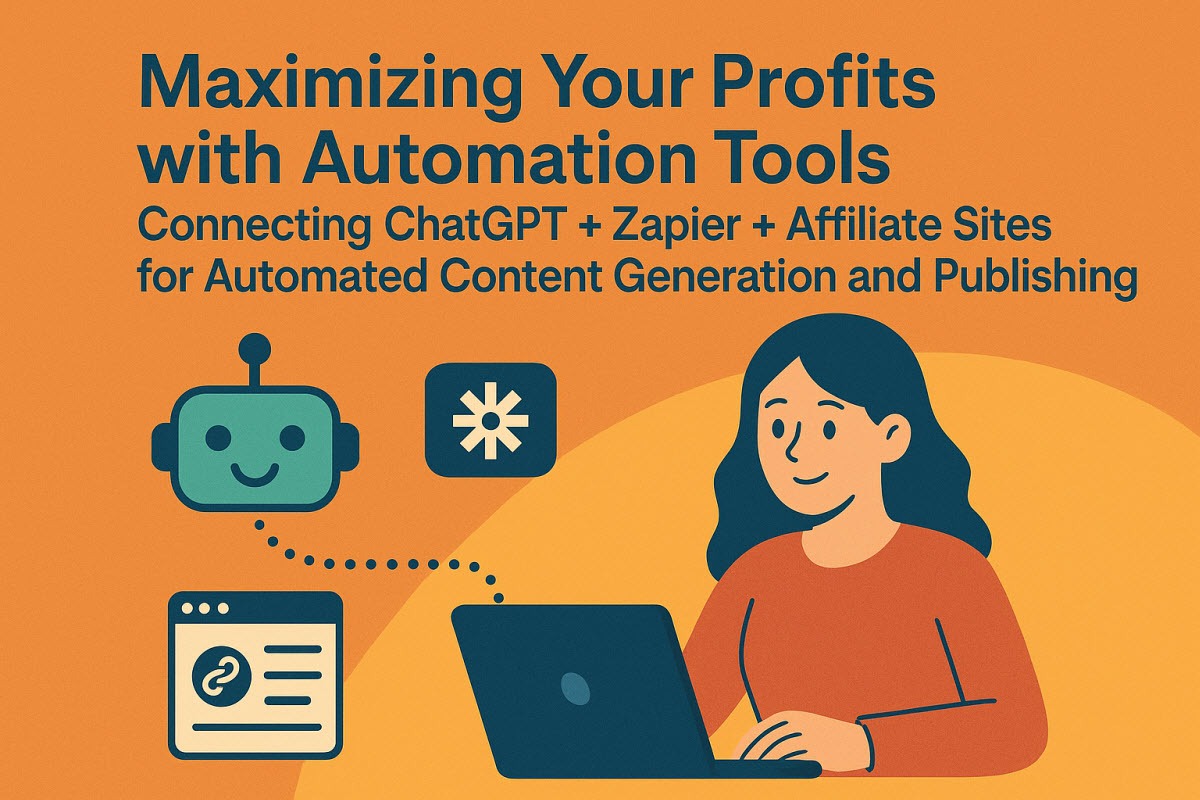

Maximizing Your Profits with Automation Tools: Connecting ChatGPT + Zapier + Affiliate Sites for Automated Content Creation and Publishing
Introduction: Intelligent Automation - The Passive Income of Tomorrow
The whole digital marketing has been dramatically transformed and still keeps changing. Content creators, marketers, and entrepreneurs have been the major agents of this positive change as they figure out new powerful ways to double their output without doubling their working hours. The secret is in strategic automation—especially the clever use of AI technology like ChatGPT, the use of a workflow automation platform such as Zapier, and affiliate marketing websites.
This detailed manual describes the methods by which you can build a system working for itself that writes content for you, spreads it on different platforms, and counts affiliate commissions without your regular work. If you are a newbie in affiliate marketing who wants to learn the basics or an experienced pro who is looking for ways to scale your business, this guide is for you as it presents you both kinds of strategies and tactics.
Recognizing the Main Elements of Your Automation Environment
What Is ChatGPT and How Does It Impact Content Creation?
Among other regular content generation tools, ChatGPT is the most sophisticated and the most advanced language model by OpenAI. Other regular content generating tools generate their results in a pre-defined manner without any real understanding of the context given, however, ChatGPT understands the context, keeps the conversation flow, and can deliver content of a human level in almost any field.
Major Capabilities That Transform ChatGPT into a Must-Have Tool for Affiliate Marketers:
- Extensive Content Generation: In 1 minute instead of 1 hour, produce product-related descriptions, comparative papers, buying guides, and educational content
- Highly Adaptable: With one prompt, fashion can be changed for blog articles, social media account descriptions, email newsletters, video narration, and advertisement texts
- Friendly to SEO: Write pieces where the main keywords can be naturally included, and the text is easy to read and attractive at the same time
- Multi-Language Content: Target different markets by generating content in different languages
- Consistency: Keep using your brand's tone and brand message throughout all your content channels
The thing that limits ChatGPT in huge content creation is the human part. Still, its power is multiplied to a large extent when it is linked with other business instruments thereby allowing automatic workflows.
Interacting with the ChatGPT API:
To set up automated workflows with ChatGPT you will need an API key. Sign up on the OpenAI platform by going to https://platform.openai.com and getting your API key. The API payment is based on the account usage, which means that you will only pay for what you use. The price for most content generation requests is just a few cents, thus making it quite affordable.
Choosing the right model is quite important:
- GPT-4o and GPT-4o-mini: The most advanced models with the highest reasoning capabilities and content quality. So, they are perfect for writing in-depth product reviews and technical content.
- GPT-3.5-turbo: Less costly and still very capable of good performance in most content generation tasks.
- GPT-4-turbo: A compromise between performance and cost for quality large-scale content
Zapier: The Central Point of Your Automation Operations
By binding together your automation components very tightly, Zapier is the device that allows innumerable apps and services to be in communication with each other without requiring any coding. If you think of Zapier as your digital operations manager, it would be the one performing the repetitive work based on the instructions given.
Fundamental concepts each affiliate marketer must know:
Zaps (Automated Workflows): A zap is a series of automated steps from one trigger (when this happens) to one or more actions (do that). For instance: "If a new topic is added to a Google Sheet, generate an article with ChatGPT and publish it to WordPress."
Triggers: The initiator of your automation event. A trigger can be a new row in a spreadsheet, an incoming email, a form submission, a certain time of the day, a new post on social media, and many more.
Actions: The tasks that Zapier performs automatically after identifying a trigger. In this case, the actions can be the following: sending emails, creating database entries, posting to social media, updating CRM records, or publishing website content.
Multi-Step Zaps: Highly complex workflows linking several actions one after another, thus enabling the most complex automation sequences that would require custom programming if done manually.
Filters and Paths: Conditional statements that determine the data your automations rely on and select the branch to be followed if different conditions thus providing the correct answers for the different situations.
Zapier can communicate with more than 7000 apps, among which are WordPress, Shopify, Google Sheets, Airtable, Slack, Mailchimp, Facebook, Twitter, and almost any major business tool. Such a vast integration network means that you can automate almost any business process that involves the flow of data between apps.
Getting started with Zapier:
Go to https://zapier.com and set up a free account to embark on your automation journey. The free plan is limited to 100 tasks per month, which is enough for trials and small-scale projects. Once your automation demand grows and you are on a paid plan that starts at a reasonable monthly fee, you will get a higher number of tasks and the possibility of accessing such features as multi-step Zaps and getting a faster execution.
Affiliate Marketing: The Art of Earning Money via the Right Partnerships
Affiliate marketing is among the simplest online business models to start with and requires only a little investment upfront, yet it has vast income potentials. What you do as an affiliate marketer is to link to the products or services of other businesses and advertise them so these businesses will give you a share of the resulting sales as a commission.
Why automation makes affiliate marketing more profitable:
Under the normal method, you are required to constantly come up with content for affiliate marketing, manually publish them, handle your social media, and always optimize. The number of tasks that you can do limits the number of affiliate programs that you can effectively promote and the amount of content that you can produce. On the other hand, an automated job is not bound by such limitations and thus allows a mode of operations that can be exponentially scaled.
Top-Converting Affiliate Program Categories:
Software and SaaS Tools: Commission rates will almost always be between 20% and 50%, and some may add that the commissions are recurring as long as the referred customers maintain their subscription. For example, Semrush pays commissions of $200 per subscription, whereas Shopify commissions up to $150 per referral.
Online Education and Courses: Commission rates by Coursera, the educational platform, are 10%-45%, and the platform comes with a bunch of courses in different niches. The rapid growth in the demand for online educational services makes this category very attractive.
Web Hosting and Domain Services: Hostings like Bluehost and WP Engine can afford to offer a pretty nice number of commissions (for example, most of $65-$200 per sale) due to the fact that web hosting has a high customer lifetime value.
E-commerce and Retail: The following networks: Amazon Associates, Rakuten, and ShareASale, offer a myriad of products for sale across a broad range of categories. Although commission rates (1-10%) are low, conversion rates are generally high due to brand familiarity.
Digital Marketing Tools: The tools involved: marketing automation, SEO tools, email platforms, and analytics services have attractive commission structures as they are the solutions to the most significant business problems for a group of people who are willing to pay.
Top affiliate networks to consider:
- CJ Affiliate (Commission Junction): https://www.cj.com - One of the major networks with over 3800 brands
- ShareASale: https://www.shareasale.com - Large number of merchants across different categories
- Rakuten Advertising: https://rakutenadvertising.com - Leading brands and attractive commissions
- ClickBank: https://www.clickbank.com - Concentrates on digital products with high commission rates
- Impact: https://impact.com - Platform with advanced tracking for large-scale businesses
- PartnerStack: https://www.partnerstack.com - B2B tech partnerships with recurring commissions
Each network is a different world in terms of approval requirements, payment minimums, and payout schedules. Most affiliate marketers open accounts in several networks in order to have a wider product selection and more commission opportunities.
Building Your Automated Content Creation Engine
Step 1: Strategic Planning and Content Architecture
Without a clear content plan that is in line with your affiliate marketing goals, you cannot think of automation. Generating content randomly is akin to throwing money down the drain and leads to poor results.
Finding Your Money-Making Niche:
Pick a specific market segment where you can be an expert and where there are a lot of opportunities for affiliate marketing. The most profitable niches are the intersection of three factors: your personal interest, market demand, and monetization potential. Some examples could be software review, fitness gear, financial services, travel gear, kitchen appliances, and online education.
Research Affiliate Programs Within Your Niche:
Locate 5-10 good affiliate programs that offer products or services your target audience truly needs. Such programs should possess the following attributes:
- Reasonable commission rates (at least 10% or $50 per sale)
- Long cookie durations (30+ days is preferred)
- Quality marketing materials and affiliate support
- Accurate tracking and prompt payments
- Products that you are honest enough to be able to recommend
Develop a content calendar framework:
Create a systematic approach to content topics that supports your affiliate goals. Content types should include:
Product Reviews: Deep analyses of specific products featuring benefits, limitations, comparisons, and personal insights. These typically convert best when targeting buyers ready to make purchase decisions.
Comparison Articles: Side-by-side evaluations of competing products help readers make informed choices while positioning your affiliate links as the logical next step.
Buying Guides: Comprehensive resources that educate readers about product categories, key features to consider, and top recommendations across different price points.
Tutorial Content: Step-by-step guides showing how to use products effectively. These build trust and demonstrate genuine expertise while naturally incorporating affiliate recommendations.
Industry News and Trends: Timely content that keeps your audience informed while establishing your site as a go-to resource within your niche.
Similar to how AI-powered SEO services create lucrative opportunities for freelancers, strategic content planning combined with automation enables you to serve clients and audiences more effectively while scaling your operations.
Step 2: Setting Up Your Content Database
Organize your content ideas and automation triggers using a centralized database. Google Sheets works excellently for this purpose due to its free accessibility, Zapier integration, and collaborative features.
Create your content planning spreadsheet:
Column A - Content Topic: The specific subject or question your article will address Column B - Content Type: Categorize as review, comparison, guide, tutorial, or news Column C - Primary Keyword: The main SEO keyword you're targeting Column D - Affiliate Programs: Which products you'll promote in this content Column E - Target Word Count: Desired article length (typically 1,500-2,500 words for SEO performance) Column F - Content Guidelines: Specific instructions for ChatGPT about tone, structure, or required sections Column G - Publication Status: Track whether content is drafted, published, or scheduled Column H - Publication Date: When the content went live Column I - Content URL: Link to the published article for reference
This structure provides everything your automation needs to generate and publish appropriate content. Each new row triggers your automation workflow, creating a simple, maintainable system.
Alternative database options:
- Airtable: https://airtable.com - Offers more sophisticated database features with excellent Zapier integration
- Notion: https://www.notion.so - Combines databases with project management for comprehensive content operations
- Monday.com: https://monday.com - Visual workflow management with robust automation capabilities
Step 3: Creating Your ChatGPT Content Generation Workflow
Now comes the exciting part—building your first automated content generation Zap that transforms database entries into published articles.
Initial Zap configuration:
- Log into your Zapier account and click "Create Zap"
- Select your trigger app (Google Sheets, Airtable, etc.)
- Choose trigger event: "New Spreadsheet Row" or "New Record"
- Connect your account and select the specific spreadsheet/table
- Test the trigger to confirm Zapier can read your data
Adding ChatGPT content generation:
- Click "Add Action" and search for "ChatGPT (OpenAI)"
- Select action event: "Conversation" or "Send Prompt"
- Connect your OpenAI account using your API key
- Configure your content generation prompt
Crafting effective content generation prompts:
Your prompt quality directly determines output quality. Effective prompts include:
Clear Role Definition: "You are an expert affiliate content writer specializing in [your niche]"
Specific Instructions: "Create a comprehensive product review article of [Product Name] that includes sections on features, benefits, limitations, ideal users, comparison with alternatives, and a final recommendation"
Tone and Style Guidelines: "Write in a conversational, helpful tone that builds trust. Use short paragraphs, bullet points for key information, and naturally incorporate the keyword [keyword] throughout the content"
SEO Requirements: "Include the primary keyword in the title, introduction, at least 2 headings, and conclusion. Use related semantic keywords naturally throughout"
Structural Requirements: "Format the article with an engaging introduction, 5-7 main sections with descriptive subheadings, and a conclusion that encourages readers to take action"
Word Count Target: "Target approximately [target] words to provide comprehensive coverage while maintaining reader engagement"
Example comprehensive prompt:
You are an expert affiliate marketing content writer specializing in technology products. Create a comprehensive, SEO-optimized product review article for {{Content Topic}} targeting the keyword {{Primary Keyword}}.

The article should:
- Begin with an engaging introduction that immediately addresses the reader's need
- Include sections on: Key Features, Performance Analysis, User Experience, Pros and Cons, Comparison with Alternatives, Who Should Buy This, and Final Verdict
- Incorporate {{Primary Keyword}} naturally in the title, introduction, at least two headings, and conclusion
- Use a helpful, authoritative tone that builds trust
- Target {{Target Word Count}} words
- End with a clear call-to-action encouraging readers to learn more or make a purchase

Additional guidelines: {{Content Guidelines}}

Format the content with proper markdown syntax including # for main title, ## for major sections, and ### for subsections. Use bullet points where appropriate for easy scanning.
The double curly braces {{Column Name}} allow Zapier to dynamically insert data from your spreadsheet, making each generated article unique and targeted.
Handling longer content:
ChatGPT has token limits that might prevent generating extremely long articles in a single response. For comprehensive content exceeding 2,000 words, use a multi-step approach:
- Generate Article Outline: First ChatGPT action creates detailed section headings
- Generate Each Section: Separate ChatGPT actions elaborate on each section
- Combine Content: Use Zapier's Formatter tool to merge all sections into complete article
This approach produces more detailed, higher-quality content while staying within API limits.
Step 4: Automated Publishing to Your Website
With your content generated, the next step connects your automation to your content management system for automatic publishing.
WordPress publishing automation:
WordPress powers over 40% of all websites, making it the most common publishing platform for affiliate marketers. Zapier's WordPress integration enables seamless automated publishing.
Configure WordPress publishing action:
- Add another action to your Zap
- Search for and select "WordPress"
- Choose action event: "Create Post"
- Connect your WordPress site (you'll need to install the WP REST API Authentication plugin)
- Configure post settings:
Title: Map from your database or use ChatGPT's output Content: Insert the article generated by ChatGPT Post Status: Choose "Draft" for review, "Publish" for immediate publication, or "Scheduled" for future posting Categories: Assign appropriate categories for organization Tags: Add relevant tags for SEO and internal organization Featured Image: Upload or select from your media library Author: Select the author account for proper attribution Excerpt: Create a meta description for SEO purposes
Important WordPress setup requirements:
Your WordPress installation must have the REST API accessible (enabled by default in modern WordPress versions). You'll need to create an Application Password from your WordPress user profile (Users > Your Profile > Application Passwords) to authenticate Zapier's connection securely.
Visit the WordPress REST API documentation at https://developer.wordpress.org/rest-api/ for technical details about API capabilities and authentication methods.
Shopify blog publishing:
For affiliate marketers using Shopify stores with blog functionality:
- Select "Shopify" as your action app
- Choose "Create Blog Article" as the action event
- Connect your Shopify store
- Map your content fields to Shopify's blog article fields
- Configure SEO settings including meta descriptions and URL handles
Medium publishing for broader reach:
Medium provides access to its built-in audience, potentially driving additional traffic to your affiliate content:
- Add "Medium" as an action
- Select "Create Story" or "Create Story Under Publication"
- Connect your Medium account
- Map your content and configure publication settings
Many successful affiliate marketers publish the same content across multiple platforms (with appropriate canonical tags to avoid SEO penalties), maximizing reach and traffic potential.
Step 5: Social Media Cross-Posting for Maximum Visibility
Every published article represents an opportunity to attract traffic through social media channels. Automate social promotion to ensure consistent visibility without manual posting.
Automated Twitter/X posting:
- Add Twitter/X as an action in your Zap
- Select "Create Tweet"
- Craft a compelling tweet template: "New article: {{Title}} [shortened URL] {{Relevant Hashtags}}"
- Consider creating multiple tweets with different angles scheduled at strategic times
Facebook page updates:
- Add Facebook Pages as an action
- Select "Create Page Post"
- Create an engaging post that teases your article's value proposition
- Include the article URL and relevant hashtags
LinkedIn sharing for professional audiences:
- Add LinkedIn as an action
- Select "Share Update"
- Format your update professionally, highlighting insights from your article
- Include link and relevant professional hashtags
Instagram content adaptation:
While Instagram doesn't support direct article links in posts, you can:
- Generate Instagram-friendly captions using ChatGPT
- Create quote graphics or key statistics from your article
- Direct followers to link in bio
Pinterest pin creation:
Pinterest drives significant referral traffic for many niches, particularly lifestyle, home, fashion, food, and DIY content:
- Add Pinterest as an action
- Create pins with eye-catching images
- Link pins to your article for traffic generation
- Use keyword-rich descriptions for Pinterest SEO
Just as building AI-powered product review websites with automatic price updates requires strategic integration of multiple technologies, effective social media automation demands thoughtful configuration of each platform's unique requirements and best practices.
Advanced Automation Strategies for Maximum Profitability
Dynamic Content Personalization Based on Audience Segments
Not all readers have identical needs or interests. Advanced affiliate marketers create multiple content variations targeting different audience segments, dramatically improving conversion rates.
Segment-based content generation:
Use Zapier's Paths feature to create conditional logic that generates different content based on audience characteristics:
Price-Sensitive Buyers: Generate content emphasizing value, budget-friendly options, and cost comparisons Premium Buyers: Focus on quality, advanced features, and exclusive benefits Technical Audiences: Include detailed specifications, performance metrics, and technical comparisons Casual Users: Prioritize ease of use, convenience, and practical benefits
Implement this by adding a "Target Audience" column in your content database, then using Paths in Zapier to route to appropriate ChatGPT prompts based on audience type.
Automated Email Sequence Creation
Email marketing consistently delivers the highest ROI of any digital marketing channel. Automate email sequence creation to nurture subscribers into affiliate customers.
Welcome sequence automation:
When someone subscribes to your email list:
- Trigger Zap captures new subscriber information
- ChatGPT generates personalized welcome email incorporating subscriber interests
- Email sends automatically through your email service provider (Mailchimp, ConvertKit, etc.)
- Follow-up emails send on scheduled delays, each containing relevant affiliate recommendations
Product launch announcements:
When you publish content about new products:
- Trigger detects new published article
- ChatGPT creates email highlighting article's key insights
- Email segments by subscriber preferences
- Scheduled send optimizes for open rates
Automated Performance Tracking and Optimization
Successful affiliate marketers continuously monitor performance metrics and optimize based on data. Automate performance reporting to identify winning strategies without manual analysis.
Create automated reporting workflows:
Daily Performance Summary:
- Schedule Zap to run daily at specific time
- Gather data from Google Analytics, affiliate networks, and WordPress
- ChatGPT analyzes data and identifies trends
- Formatted report emails to you with insights and recommendations
Top-Performing Content Identification:
- Weekly Zap pulls traffic and conversion data
- Identifies top 10 performing articles
- Generates similar content automatically to capitalize on success
- Updates content calendar with winning topics
Low-Performing Content Optimization:
- Identify underperforming content through analytics
- ChatGPT suggests optimization improvements
- Create tasks in project management system for manual review
- Track optimization impact over time
Seasonal and Trending Content Automation
Capitalize on seasonal opportunities and trending topics by automating timely content creation.
Holiday and event-based content:
Create a calendar of relevant holidays, shopping events (Black Friday, Prime Day, holiday seasons), and industry events. Schedule Zaps to:
- Trigger content generation 2-3 weeks before events
- Generate gift guides, deals roundups, or event-specific content
- Automatically publish on optimized schedule
- Cross-post to social media with event-specific hashtags
Trend monitoring and response:
Advanced affiliates monitor their niche for trending topics and respond quickly:
- Use RSS feeds or Google Alerts as triggers
- Filter trends relevant to your niche
- Generate timely content about trending topics
- Publish rapidly to capture search traffic
Common Challenges and Solutions
Challenge 1: Content Quality and Authenticity
Problem: Automated content sometimes lacks the personal touch and authentic voice that builds reader trust.
Solutions:
Detailed Prompting: Invest time creating comprehensive prompts that capture your unique voice, perspective, and expertise. Include examples of your writing style in prompts.
Manual Review Stage: Configure your Zap to create drafts rather than immediately publishing, allowing manual review and enhancement before publication.
Hybrid Approach: Use automation for initial drafts and outlines, then add personal experiences, specific examples, and unique insights manually.
Voice Development: Create a "style guide" document that ChatGPT references, maintaining consistency across all automated content.
Challenge 2: SEO Optimization
Problem: Simply generating content doesn't guarantee search engine visibility.
Solutions:
Keyword Integration: Include comprehensive keyword instructions in your ChatGPT prompts, specifying primary keywords, semantic variations, and natural incorporation requirements.
Structured Data: Use additional Zap steps to add schema markup, helping search engines understand your content context and improving rich snippet opportunities.
Internal Linking: Manually add strategic internal links connecting related articles, or create a separate automation that suggests relevant internal links based on topic similarity.
Meta Description Optimization: Generate compelling meta descriptions with ChatGPT that incorporate target keywords while encouraging clicks.
Content Freshness: Schedule regular content updates using automation to maintain search rankings and relevance.
Challenge 3: Avoiding Duplicate Content Penalties
Problem: Publishing similar content across multiple platforms might trigger duplicate content penalties.
Solutions:
Content Spinning with Intent: When publishing to multiple platforms, use ChatGPT to create unique variations maintaining core message but varying structure, examples, and phrasing.
Canonical Tags: Implement proper canonical tags pointing to your primary content source, signaling to search engines which version to prioritize.
Platform-Specific Formatting: Adapt content to each platform's unique characteristics—thread-style for Twitter, visual-first for Medium, professional tone for LinkedIn.
Excerpt Publishing: Post article excerpts or summaries on secondary platforms with links to full content on your primary site.
Challenge 4: API Costs and Budget Management
Problem: High-volume content generation can accumulate significant API costs.
Solutions:
Model Selection: Use cost-effective models like GPT-3.5-turbo for straightforward content, reserving GPT-4 for complex, high-value articles.
Token Optimization: Craft efficient prompts that achieve desired results with minimal token usage. Avoid unnecessary verbosity in instructions.
Batch Processing: Group similar content generation tasks to minimize API calls and maximize efficiency.
Budget Monitoring: Set up spending alerts in your OpenAI account and Zapier to prevent unexpected cost overruns.
ROI Focus: Continuously evaluate whether API costs remain justified by affiliate revenue generated. Successful automation should produce multiple dollars in revenue for every dollar spent on API costs.
Measuring Success and Scaling Your Operations
Key Performance Indicators to Track
Content Production Metrics:
- Articles published per week/month
- Average time from idea to publication
- Content production cost per article
- Content quality scores (readability, SEO optimization)
Traffic Metrics:
- Organic search traffic growth
- Social media referral traffic
- Email click-through rates
- Time on page and bounce rates
Monetization Metrics:
- Affiliate click-through rates
- Conversion rates per affiliate program
- Revenue per article
- Customer lifetime value
- Return on investment (ROI) for automation costs
Operational Metrics:
- Automation execution success rate
- Time saved versus manual processes
- Error rates and resolution times
- System reliability and uptime
Scaling Your Automated System
Once your foundational automation proves profitable, systematic scaling multiplies results:
Horizontal Scaling (More Content):
- Increase content calendar volume
- Expand into related sub-niches
- Create content in multiple languages
- Develop content for additional seasonal opportunities
Vertical Scaling (Better Content):
- Enhance prompt engineering for superior quality
- Add multimedia elements (images, videos, infographics)
- Develop more comprehensive, authoritative content
- Increase word counts for competitive keywords
Platform Scaling:
- Launch additional websites targeting different niches
- Expand to additional social media platforms
- Build email lists in multiple market segments
- Create YouTube or podcast content with automation support
Affiliate Program Scaling:
- Join additional high-paying affiliate programs
- Negotiate higher commission rates based on performance
- Develop direct partnerships with brands
- Create custom affiliate funnels with higher conversion rates
Similar to how selling exclusive content on subscription platforms requires understanding your audience and delivering consistent value, scaling automated affiliate operations demands continuous optimization and strategic expansion into profitable opportunities.
Ethical Considerations and Best Practices
Transparency with Your Audience
Successful affiliate marketers build lasting businesses through trust and transparency:
Disclosure Requirements: Always clearly disclose affiliate relationships in accordance with FTC guidelines and local regulations. Include affiliate disclaimers on every page containing affiliate links.
Honest Recommendations: Only promote products you genuinely believe provide value to your audience. Your reputation depends on making trustworthy recommendations.
Balanced Reviews: Acknowledge both strengths and limitations of products. Overly promotional content erodes credibility and reduces conversion rates.
Personal Experience: Where possible, incorporate genuine personal experience with products. This authenticity differentiates your content from purely automated competitors.
Quality Over Quantity
While automation enables massive content production, focus on quality:
Strategic Publishing: 10 excellent, well-optimized articles outperform 100 mediocre ones. Prioritize quality in your automation configuration.
Regular Audits: Periodically review automated content to ensure quality standards remain high. Adjust prompts and processes based on performance data.
Human Oversight: Maintain human review processes for high-stakes content, particularly product reviews with significant price points or legal implications.
Continuous Improvement: Use reader feedback and performance data to continually enhance your content generation processes.
Resources and Tools for Continued Success
Essential Tools and Platforms
Automation and Integration:
- Zapier: https://zapier.com - Primary automation platform
- Make (Integromat): https://www.make.com - Alternative automation platform with visual workflows
- n8n: https://n8n.io - Open-source automation for technical users
AI Content Generation:
- OpenAI API: https://platform.openai.com - Access to ChatGPT for automation
- Anthropic Claude: https://www.anthropic.com - Alternative AI model
- Jasper AI: https://www.jasper.ai - Specialized marketing AI
Content Management:
- WordPress: https://wordpress.org - Most popular CMS for affiliate sites
- Webflow: https://webflow.com - No-code website builder with powerful design
- Ghost: https://ghost.org - Modern publishing platform for content creators
Email Marketing:
- ConvertKit: https://convertkit.com - Creator-focused email platform
- Mailchimp: https://mailchimp.com - Popular full-featured email service
- ActiveCampaign: https://www.activecampaign.com - Advanced automation features
Analytics and Tracking:
- Google Analytics: https://analytics.google.com - A must-have website analytics tool
- Google Search Console: https://search.google.com/search-console - SEO performance tracking
- Fathom Analytics: https://usefathom.com - A privacy-centered analytics alternative
SEO Tools:
- Semrush: https://www.semrush.com - A complete SEO and keyword research tool ($200 per referral)
- Ahrefs: https://ahrefs.com - Backlink analysis and keyword research
- Surfer SEO: https://surferseo.com - An SEO tool that helps content creators
Affiliate Networks:
- CJ Affiliate: https://www.cj.com
- ShareASale: https://www.shareasale.com
- Impact: https://impact.com
- Rakuten: https://rakutenadvertising.com
- ClickBank: https://www.clickbank.com
- Amazon Associates: https://affiliate-program.amazon.com
Learning Resources
Zapier Resources:
- Zapier Learn: https://learn.zapier.com - Free automation courses
- Zapier Blog: https://zapier.com/blog - Latest news, tips, and strategies on automation
- Zapier Community: https://community.zapier.com - Help and advice from peers
ChatGPT and Prompt Engineering:
- OpenAI Documentation: https://platform.openai.com/docs - Official API documentation
- Learn Prompting: https://learnprompting.org - A complete guide to prompt engineering
- Prompt Engineering Guide: https://www.promptingguide.ai - Advanced prompting techniques
Affiliate Marketing Education:
- Authority Hacker: https://www.authorityhacker.com - Advanced affiliate marketing strategies
- Affiliate Marketing Subreddit: https://www.reddit.com/r/affiliatemarketing - Community discussion
- Pat Flynn's Smart Passive Income: https://www.smartpassiveincome.com - Transparent affiliate case studies
Conclusion: Your Path to Automated Affiliate Success
Combining artificial intelligence, workflow automation, and affiliate marketing is a prerequisite for online business models that are not only scalable, but also very profitable at a level that has never been seen before. By the careful setup of the systems described in this guide, you can:
- Continuously produce content of the highest standard without your time being taken up
- Be present on different channels at the same time
- Grow your business without the need to increase work hours and expenses proportionally
- Strategize, optimize, and grow your business by freeing up the time and energy which would otherwise be spent on routine tasks
- Use intelligent automation to create a source of passive income which is sustainable
Automation is a tool in your strategy—it helps good strategies achieve results faster and at a larger scale, but it also amplifies mistakes. Spend your time on strategic planning, choosing good niches, signing up for quality affiliate programs, and creating effective prompts. These base factors are much more decisive of your success than how sophisticated your automation is.
It's not a good idea to make a big move right away. Carry out in-depth tests and gradually increase your volume. Your content strategy, affiliate program, and automation workflow can be at a very basic level individually when you start. The results should be measured, the improvements identified, and the activities extended systematically. This measured approach to which risk is largely mitigated while giving you the opportunity to learn and optimize before a large resource investment.
The ones who will be able to effectively use automation, at the same time preserve the human elements such as trust, authenticity, and strategic thinking, will be the winners of the affiliate marketing battle. What your automated systems are accomplishing is taking care of the repetitive tasks, thus, they are giving you the freedom to focus on the things which are most essential to the growth of your business, for example, knowing your audience better, selecting the right products to promote, and continually updating your strategy based on the data and feedback.
Do it today. Pick your niche, your first affiliate program, start building your content bank, and create your first automated workflow. Every action you take moves you forward exponentially and after a while, you will have built a strong automated system that is running when you're sleeping, traveling, or occupied with new projects.
The tools are here for you. The doors are wide open. Your success will be the result of strategic execution, constant fine-tuning, and a commitment to delivering real value to your audience. There's no better time than now to start building your automated affiliate empire.
Want to know more? Additional materials to check out:
- Discover 10 exclusive content ideas you can sell on subscription platforms for separate revenue streams
- Learn how AI-powered SEO services create lucrative opportunities for freelancers
- Master the art of building AI-powered product review websites with automatically updated prices
Your automated affiliate success journey starts here. Take the first step and let automation transform your online business potential.